Senior Technical Systems Designer / Senior Technical Game Designer


Senior Technical Game Designer
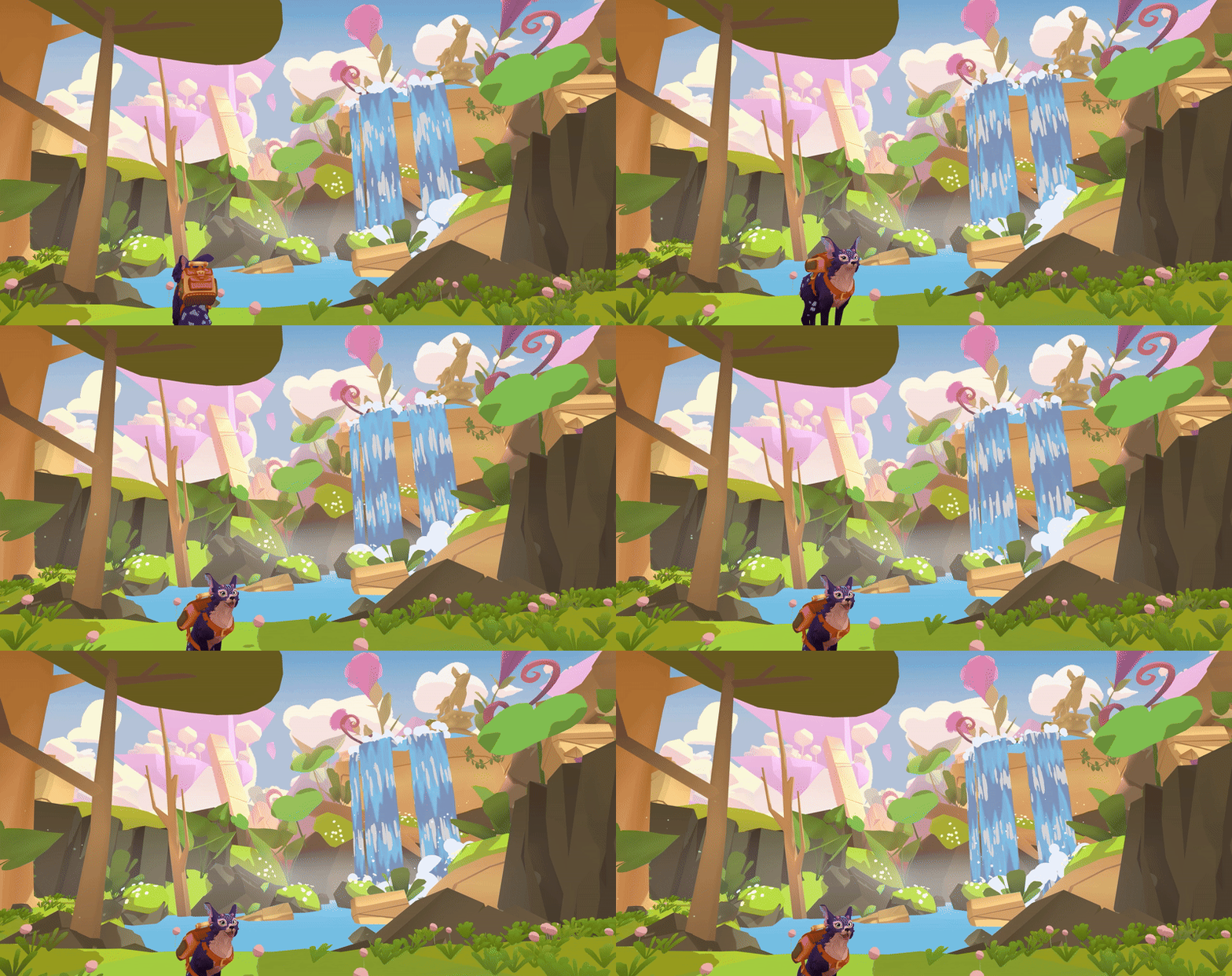
Stay: Forever Home is a Mixed Reality and VR pet simulation game about Ember, a magical creature who comes to live with you. Enter into Ember's world to go for walks, collect resources to trade for items, and interact with mischievous critters.
Studio | Windup Minds
Role | Senior Technical Game Designer
Duration | 2023 - 2026
Team Size | 15+
Languages | C#, Behavior Tree, Shader Graph
Tools | Unity, Spreadsheets, Miro, Notion, Gitlab
Platforms | Quest 2, Quest 3, Quest Pro
Stay: Forever Home released on Quest 2 & 3 May 2025
❖ Rated 4.6 Stars on Meta Quest Store
❖ Gathered a discord community of 1.5k members
About:
I joined Windup Minds as one of the first 8 people on the team, to help prototype creature AI and gameplay for the VR/Mixed Reality pet simulation game that would come to be called Stay: Forever Home.
Over the course of 3 years, I harnessed my technical and game design skills to own and bring to fruition lifelike creature AIs, immersive VR/Mixed Reality interactions, and extensive creature and home customizations.
My Role:
As Senior Technical Game Designer on Stay: Forever Home, I primarily:
In addition, I also:
-
Optimized the first-time-user-experience funnel based on analytics, increasing FTUE completion rate from 23% to 68%.
-
Wrote and assembled pitch materials for publishers and investors.
-
Created detailed feature specs, inviting all disciplines to weigh in.
-
Collaborated with leads to plan production schedules and make tradeoffs where needed.
-
Created debug tools, design authoring tools, and TSV import tools to streamline QA and design iteration.
-
Implemented 250+ in-game toys, accessories, decorations, treats, and consumables.
-
Served as a pragmatic voice when needed to cut, scope, and organize focus areas in order to meet our milestones and ship date.


> Here are a few examples of my work on the project. <
1. Prototyped foundational gameplay and progression
I utilized my coding, visual scripting, and design skills to rapidly stand up several gameplay and progression prototypes.
Early Prototyping: Invaders, Wind, and Gardening Prototypes
These are a few of the several early gameplay prototypes I made, each taking 1-3 days.
The invaders prototype was about working together with your pet to chase away little critters that invaded your home and tried to steal your crops. The wind prototype had the player swing their arms to power up their pet's movements, and the gardening prototype tested how it would feel for the pet to have a more supportive role and recipient of crafted goods.


Magic Walk
I prototyped and iterated Magic Walk, a magical radius around the pet which activated nearby interactables, resources, and mossling encounters. The intention was to force the player to traverse with the pet rather than rushing ahead.
In an attempt to integrate Magic Walk into core progression, I tried implementing a 'mana bar,' which would deplete as you walked and could be improved over the course of play. However, the mana bar introduced several core experiential problems:
-
The mana bar made Ember feel like a tool.
-
Players felt bad about draining Ember's magic.
The mana bar was removed, but Magic Walk itself was successful in encouraging players to stay near the pet so stayed.


Core Progression Paper Prototyping
I initially modelled the core progression systems through paper, to get a sense of it quickly without code.
I went through several iterations of paper prototypes. Many of the scrapped systems resurfaced in the Steam version of the game that was developed in 2026.


Trade Levels, Friendship Levels, Forage Levels, and Wants
Trading served as a resource sink and the main activity the player could do each day. The player could trade for daily goods and upgrades in order to fulfill the pet's wants, which would increase Friendship Level and unlock new behaviors and commands with the creature.


I built Ground Pound and Telekinesis prototypes, aiming to introduce new verbs for the player and pet to solve puzzles and advance through environments together.


2. Scripted, iterated, and tuned 60+ creature AI behaviors/interactions for 2 NPC types
I worked extensively on the creature AI behaviors for both the main pet character and the small critters, starting from behavior trees in early prototypes, then migrating over to Utility AI to create 2 types of dynamic, responsive creatures.
The behavior tree nodes were easy to set up but difficult to tune and unscaleable for the complexity of behaviors we wanted our pet creature to display. Here are snippets of Perry (green cube) and Otto (sphere dog)'s behavior trees that I built in the Behavior Designer node graph as very early iterations of the pet's AI.


When we switched over to utility AI, over the course of two years, I programmed in C# and tuned 95% of the individual actions that comprise of Ember's AI (50+ actions). Each new action and action set took days to weeks to balance their scores, considerations, state-associations, etc. to keep the creature dynamic yet consistent in behavior.


I also built the Mossling AI actions and locomotion system using Ember's AI as a baseline but stripping out most of the complexities that made Ember's AI a bit too heavy for the little critters.


The biggest challenge was maintaining dynamism for both NPC types, tuning their behaviors so that they not only respond to each other but also react and act on the player.
3. Designed and polished VR/Mixed Reailty interactions
Though it was my first time developing in VR and Mixed Reality, I spent a lot of time in-headset to prototype, build, and polish interactions that would be intuitive, delightful, and immersive.
Moving Room Prototype
These prototypes transformed your room into a moving vehicle, seamlessly transitioning between Mixed Reality and VR.


Door Item
The moving room prototype turned out to be a bit motion-sickness inducing, so I created a door prototype which would facilitate transitions between Mixed Reality and VR. I chose a door rather than a standard portal, to make it more whimsical.


Trade Board interactions
I implemented and tuned interactions such as lifting up and down the trade board height using the side handles, interacting with trade cards, opening and closing the mailbox door, and grabbing and placing it like with the door item.


4. Owned seasonal events and feature flags post-launch
Immediately following launch, I collaborated with artists to plan 1 year's worth of seasonal event drops for summer, halloween, winter holidays, and valentines day, as part of the team's plan to support retention and discourse.
Each seasonal event lasted only one month and consisted of limited-time seasonal accessories, toys, and decor which could only be obtained through foraging seasonal resources, like watermelons in summer, candy canes in winter, and so on.


Seasonal event content was designed to be lightweight in development cost and make use of as many existing systems as possible such as foraging with magic walk, trading, and Ember's wants system.
With light engineering oversight, I was able to program into the trading system support for seasonal event trades, integrate season visuals and seasonal trades to feature flags, and add analytics for seasonal content.


I kept a close eye on Day 1, 7, 14, and 30 retention as well as analytics and observed 20%-80% increased retention for the 2-3 weeks following each seasonal event update.
However, because the content updates contained no new gameplay, the overall impact of the updates remained extremely limited.